For many Kenyan homes, schools, farms, hotels and commercial developments, a borehole is the most dependable way to secure water. County supplies are often rationed, water vendors are expensive, and rainfall is uneven from season to season. A well-sited, properly constructed and legally authorised borehole can supply water for decades.
A borehole is also a significant engineering investment, and groundwater is a shared public resource. This guide covers what property owners should understand before drilling in Kenya in 2026: the survey, the approvals, the construction stages, testing, the factors that affect cost, and the mistakes to avoid.
Why boreholes matter in Kenya
Groundwater supports a large share of Kenya’s domestic, institutional and agricultural water use, especially where piped networks do not reach or cannot keep up with demand. For a property owner, a borehole offers:
- Supply security during rationing, network failures and dry spells.
- Control over quality, because the water can be tested and treated for your specific use.
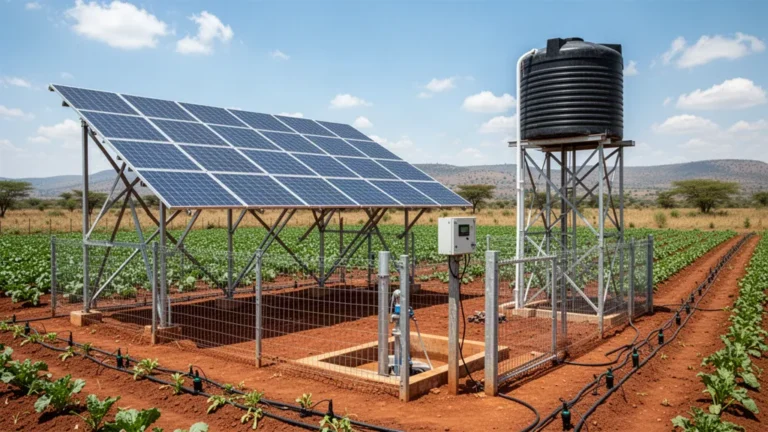
- Predictable operating costs once the system is installed, particularly when paired with solar pumping.
Aquifers are not unlimited, however. Where boreholes are crowded together, water levels can fall and neighbours can affect one another. Kenyan law regulates groundwater for that reason, and responsible borehole development starts with understanding the aquifer beneath your land.
Step 1: The hydrogeological survey
A hydrogeological survey is the starting point. A qualified hydrogeologist studies the local geology, existing boreholes in the area, available groundwater data and, usually, geophysical measurements taken on site (for example, resistivity soundings). The report recommends whether drilling is advisable, the best drilling point or points, an expected depth range and the likely yield and water quality.
Under the Water Resources Regulations, 2021, where a borehole is to be equipped with a motorised pump, the application to the Water Resources Authority (WRA) must be accompanied by a Hydrogeological Survey Report in the form set out in the Regulations (regulation 51). A good survey also records nearby boreholes, their distance from the proposed site and how they are used. This matters because WRA may require tests on existing boreholes when a new one is being constructed within 500 metres of them (regulation 52).
A survey reduces the risk of drilling a dry or low-yielding hole, but it cannot eliminate it. Treat any contractor who “guarantees” water before a survey with caution.
Step 2: Approvals before drilling
Groundwater in Kenya is managed by the Water Resources Authority under the Water Act, 2016. In outline:
- Apply to WRA for approval. A person intending to abstract groundwater applies in Form WRA 001. WRA then determines the category of the activity (Categories A to D, according to its potential impact), and the category decides which procedure and documents apply.
- Environmental requirements. Depending on the scale, location and category of the project, an environmental impact assessment and a licence from the National Environment Management Authority (NEMA) may be required. Your hydrogeologist or environmental consultant should confirm this for your specific project.
- County and local requirements. Some counties and water service providers have their own requirements, such as county approvals or letters of no objection. Check with your county before work starts.
Drilling first and “regularising later” is a false economy. Unauthorised works can attract penalties, and a borehole without the right paperwork can cause problems when the property is sold, financed or inspected.
Step 3: Drilling and construction
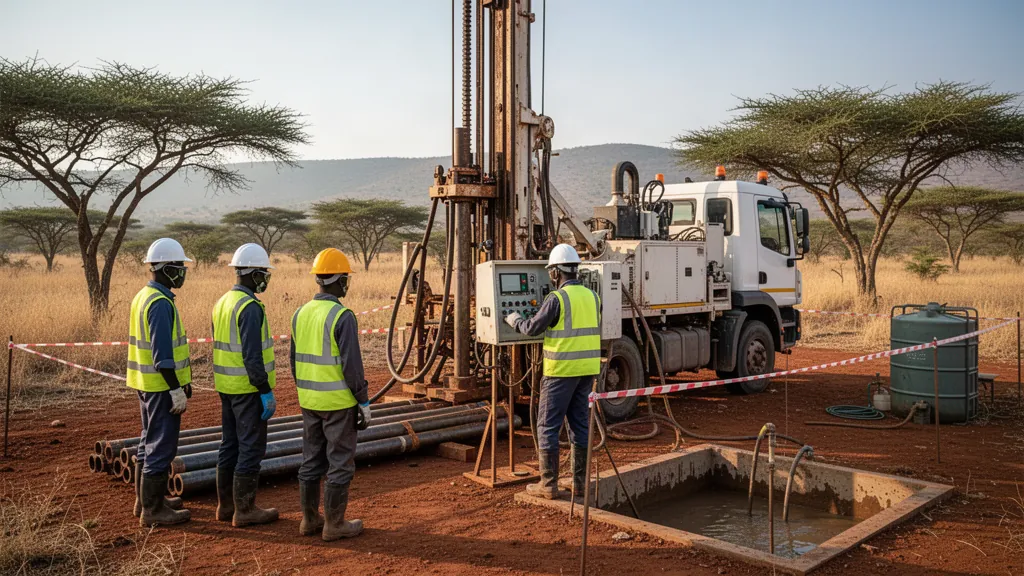
A typical borehole project follows these stages:
- Mobilisation and site preparation: access for the rig, a safe, cordoned work area, water for drilling and a plan for drilling fluids and cuttings.
- Drilling: usually by rotary or down-the-hole hammer methods, depending on the geology. The driller logs the rock types and the depths where water is struck.
- Casing and screens: plain casing supports the hole, and screens are placed against the water-bearing zones. Materials and diameters should suit the depth, the water chemistry and the intended pump.
- Gravel pack and sanitary seal: a graded gravel pack around the screens limits sand entry. A grout seal near the surface stops contaminated surface water from running down the outside of the casing.
- Development: the borehole is cleaned, often by air-lifting, until the water runs clear and fine particles are removed.
- Headworks: a raised, sealed borehole head and a concrete apron that drains surface water away.
Under regulation 54, a borehole that is to be equipped with a motorised pump must be constructed under the supervision of a qualified and licensed water sector professional.
Step 4: Test pumping and yield assessment
Test pumping tells you how much water the borehole can safely supply. For a borehole to be equipped with a motorised pump, the Regulations require a continuous, constant-rate pumping test of not less than 24 hours, followed by a recovery period of not less than 20 hours, unless WRA stipulates otherwise (regulation 53).
The test results are used to set a safe pumping rate and the pump installation depth. Pumping a borehole harder than its tested capacity can draw water levels down to the pump, draw in sand and damage both the borehole and the pump.
Within 28 days of completing the works, the applicant must submit a borehole completion record to WRA, together with the completion certificate (regulation 55). Keep copies of the survey report, the drilling log, the test-pumping data and the completion record. They are valuable for maintenance and for any future buyer.
Step 5: Water quality testing
Never assume that clear borehole water is safe. Before the water is used for drinking or food preparation, have samples analysed by a competent laboratory for:
- microbiological safety (for example, E. coli);
- key chemical parameters such as fluoride, nitrate, iron, manganese, hardness and salinity (total dissolved solids or conductivity).
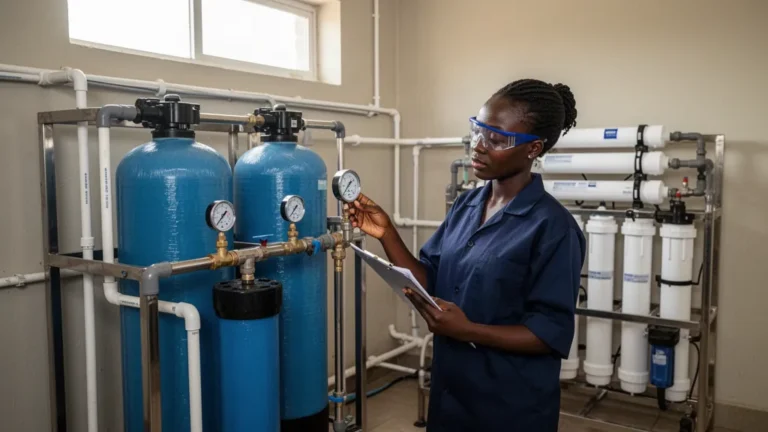
Results should be compared against the Kenyan potable water standard published by the Kenya Bureau of Standards (KEBS) and the World Health Organization guidelines. Parts of Kenya, including areas of the Rift Valley, are known for naturally high fluoride. Some coastal and arid areas have saline groundwater. Our guide to borehole water quality and treatment explains the options when results exceed the limits.
Step 6: Pump selection and installation
The pump should be selected from the test-pumping results, not from the size of the tank or a supplier’s stock. The main factors are:
- the safe yield and the pumping water level;
- the total head: the lift from the water level plus delivery height, pipe friction and any pressure required;
- the daily water demand and the storage available;
- the power source: grid, generator or solar;
- protection: dry-run protection, correct cable sizing, surge protection and a lockable, ventilated control enclosure.
What affects borehole costs?
Borehole prices vary widely across Kenya, so treat any single “average price” with caution. The main cost drivers are:
- Depth, which depends on the local geology and water levels.
- Geology: hard rock, collapsing formations and boulders all slow drilling.
- Casing materials and diameter.
- Site access and distance from the contractor’s base.
- Survey, approvals and supervision requirements.
- Test pumping and laboratory analysis.
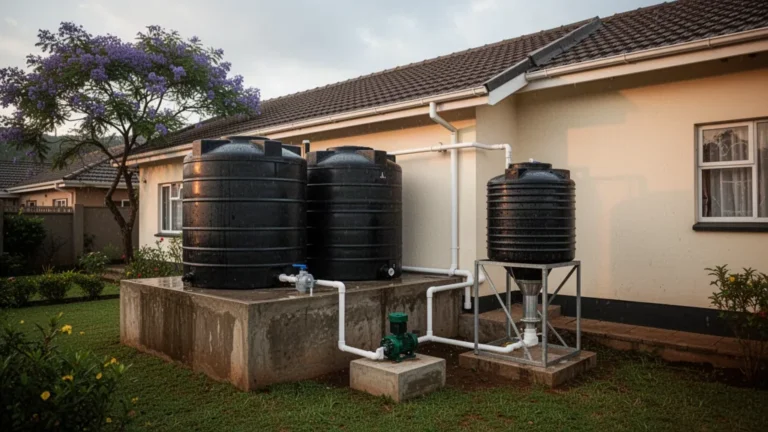
- Pump, power supply, storage and treatment, which are often a large share of the total cost.
Ask for an itemised quotation that separates these elements and states what happens, and what you pay, if the borehole is dry or low-yielding.
Common mistakes to avoid
- Drilling without a hydrogeological survey or the required approvals.
- Choosing a contractor on the lowest price per metre alone.
- Skipping the sanitary seal or the concrete apron, which leaves the borehole open to contamination.
- Siting the borehole near pit latrines, septic tanks or soakaways. Separation should be assessed by your hydrogeologist and checked against county requirements.
- Installing an oversized pump that over-pumps the borehole.
- Drinking the water before it has been tested.
- Losing the paperwork: survey, logs, test data and completion record.
Checklist before hiring a borehole contractor
- Will a qualified hydrogeologist carry out the survey and sign the report?
- Will the contractor handle, or guide you through, the WRA application and any NEMA and county requirements?
- Is the drilling and construction supervised by a licensed water sector professional?
- Does the quotation specify the casing, screens, gravel pack, sanitary seal and headworks?
- Does it include a 24-hour constant-rate pumping test with recovery, and a water quality analysis?
- Will you receive the drilling log, test data and completion record?
- Will the pump be selected from the test results, with protection devices included?
- What happens if the borehole is dry or low-yielding?
How Weber Works can help
Weber Works Ltd provides borehole solutions and pump installation across Kenya. We can help you assess your site, plan the approvals and match the pump, power, storage and treatment to what your borehole can actually deliver.
This article is general information about Kenyan requirements as at the review date shown. It is not legal advice or a design for your site. Always confirm current requirements with WRA, NEMA and your county government.