Borehole water often looks clean, and much of the time it is good water. Groundwater can still carry substances you cannot see, taste or smell, and others that are harmless but stain sinks, block pipes or make tea taste odd. Before you treat borehole water, or decide that it does not need treatment, you need to know what is actually in it.
This guide explains the common groundwater quality concerns in Kenya, how to read a laboratory report, and the treatment options that suit Kenyan homes, schools, hotels and businesses.
Three different kinds of water quality problem
Separating three categories avoids both complacency and unnecessary spending:
- Health risks: substances or organisms that can cause illness, such as faecal bacteria or excess fluoride. These need treatment that is proven to work, and they need to be checked.
- Aesthetic and operational problems: issues that affect taste, colour, staining, scaling or equipment life, such as iron, manganese and hardness. They are mostly not a direct health risk at typical levels, but they can make water unpleasant or costly to use.
- Laboratory-confirmed contaminants: what your own water contains, as measured by a competent laboratory. Treatment should be designed around confirmed results, not assumptions about “the area” or a single home test strip.
Groundwater quality concerns in Kenya
Fluoride
Naturally high fluoride is well documented in parts of Kenya, particularly areas of the Rift Valley with volcanic geology. The World Health Organization (WHO) guideline value for fluoride in drinking water is 1.5 mg/L. Long-term consumption above this level can cause dental fluorosis (mottled, brown-stained teeth), and at higher exposures, skeletal fluorosis. Fluoride cannot be seen or tasted, and boiling does not remove it.
Salinity (dissolved salts)
Some boreholes, especially in coastal, arid and semi-arid areas, produce brackish water with high total dissolved solids (TDS) or conductivity. According to WHO, water with TDS below about 600 mg/L is generally considered to taste good. Above roughly 1,000 mg/L it becomes increasingly unpalatable. Salty water also corrodes pipes, fittings and appliances, and it can damage crops and soils when used for irrigation.
Iron and manganese
Iron and manganese are very common in Kenyan groundwater. Water may come out of the tap clear and then turn orange-brown or black after standing, staining laundry, tiles and tanks. WHO does not set a health-based guideline for iron, but notes that staining and taste problems commonly occur above about 0.3 mg/L. Iron also encourages iron bacteria, which can clog pipes and pump intakes.
Hardness
Hard water forms scale in kettles, geysers, boilers and pipes, and it reduces how well soap lathers. It is mainly an operational and cost issue, not a direct health concern.
Microbiological contamination
Bacteria and other pathogens can enter a borehole through a poor sanitary seal, a damaged borehole head, a contaminated tank or a nearby pit latrine or septic system. Drinking water should contain no detectable E. coli (or thermotolerant coliforms) in any 100 mL sample. Microbial contamination can change after heavy rain, so one good result is not a lifetime guarantee.
Other chemicals
Depending on the location and nearby land use, a laboratory may also recommend testing for nitrate (often linked to sanitation or fertiliser), arsenic or other metals.
Laboratory water testing
A meaningful water test starts with a correct sample: collected in clean bottles supplied by the laboratory, after the pipes have been flushed, and delivered quickly (and kept cool for microbiological tests). Use a competent, preferably accredited, laboratory. Compare the results with the Kenyan potable water standard published by the Kenya Bureau of Standards (KEBS) and with the WHO Guidelines for Drinking-water Quality.
A practical approach is:
- New boreholes: a full physico-chemical and microbiological analysis before the water is used for drinking.
- Existing systems: periodic microbiological testing, and repeat testing after repairs, flooding or a change in taste, colour or smell.
- After treatment is installed: test the treated water to confirm that the system works.
Treatment technologies
Sediment filtration
Cartridge or media filters remove sand, silt and suspended particles. They protect downstream equipment and are usually the first stage of any treatment train.
Iron and manganese removal
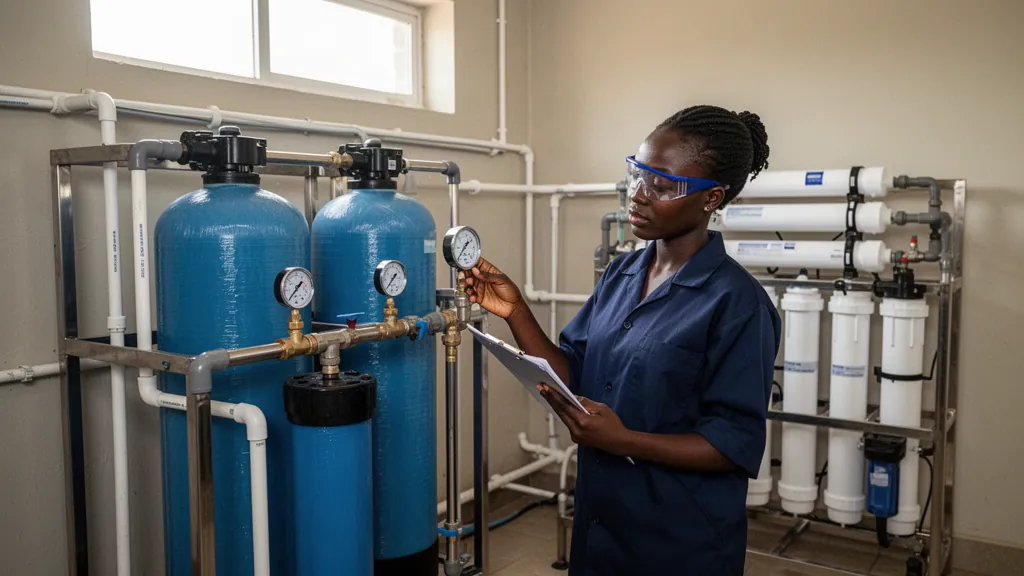
Iron removal usually relies on oxidation followed by filtration. Aeration or a chemical oxidant converts dissolved iron into particles, and a pressure filter with suitable catalytic media captures them. The filter is backwashed regularly to clean it. The right media and backwash frequency depend on the iron and manganese levels and the pH.
Softening
Ion-exchange softeners reduce hardness to protect boilers, laundries and kitchens. They need regular regeneration with salt and are typically applied to hot-water or process lines rather than all drinking water.
Reverse osmosis (RO)
RO pushes water through a fine membrane that removes most dissolved salts, including fluoride, nitrate and salinity. It is the standard solution for brackish water and is widely used for fluoride. Important considerations:
- RO needs good pre-treatment (sediment and, where needed, iron removal and antiscalant dosing) or the membranes foul quickly.
- It produces a concentrate (reject) stream that must be disposed of responsibly.
- Permeate is low in minerals, so remineralisation or blending may be added for taste and to protect pipes.
- Many properties treat only drinking and cooking water with RO, which keeps capital and running costs down.
Fluoride-specific media
Adsorption media such as activated alumina or bone char can also reduce fluoride, particularly for smaller supplies. Performance depends on the water chemistry, and the media must be replaced or regenerated on schedule, so monitoring is essential.
Disinfection
Disinfection inactivates bacteria and viruses:
- Chlorination leaves a protective residual in tanks and pipes, which is useful for institutions and larger networks.
- Ultraviolet (UV) leaves no residual and needs clear, iron-free water. It is often the final stage after filtration or RO.
Disinfection does not remove chemicals such as fluoride or salts, and it is not a substitute for a well-sealed borehole and clean storage.
Maintenance considerations
Every treatment system is only as good as its maintenance. Plan and budget for:
- cartridge filter replacement and media filter backwashing;
- RO membrane cleaning and replacement, and monitoring of pressures and permeate conductivity;
- salt for softeners and chemicals for dosing systems;
- UV lamp replacement on schedule and cleaning of the quartz sleeve;
- periodic laboratory testing to confirm performance;
- regular tank cleaning, because treated water can be recontaminated in dirty storage.
Keep a simple logbook of readings, filter changes and test results. It makes problems easier to diagnose.
When specialist testing is necessary
Seek specialist testing and advice when:
- a borehole is new, or the water will supply a school, clinic, hotel, food business or many households;
- you are in an area known for high fluoride or saline groundwater;
- there is a pit latrine, septic system, fuel store, livestock unit or farmland nearby;
- people report stomach illness, or the water’s taste, colour or smell changes;
- a treatment system is not performing as promised.
How Weber Works can help
Weber Works Ltd designs and installs water treatment systems, from iron filtration and softening to reverse osmosis and disinfection, based on your laboratory results. If you are planning a new source, see our borehole solutions.
This article is general information as at the review date shown. It is not a substitute for laboratory analysis or professional advice on your water supply.