A clean, inviting swimming pool is a major asset for a Kenyan hotel, an apartment block or a family home. A poorly managed pool is a different matter: it wastes water and electricity, it is expensive to repair and it can be a health and safety risk. Much of a pool’s running cost is decided by how well it is maintained, not by how much was spent building it.
This guide explains where pool operating costs come from, and how hotels, apartments and homeowners can cut water, energy and repair bills while keeping swimmers safe.
Where pool operating costs come from
- Electricity for the circulation pump, often the largest energy user, plus any heating and lighting.
- Water to replace evaporation, splash-out, backwashing and leaks.
- Chemicals for disinfection and water balance.
- Repairs to pumps, filters, pipework, tiles and fittings, many of which are caused by poor water chemistry or neglect.
- Labour for cleaning, testing and supervision.
Small improvements in each area add up, especially for hotels and apartment pools that run every day of the year.
Water circulation and filtration
A pool stays clear because water is continuously circulated through a filter and then disinfected. Key points:
- Turnover: the whole volume of the pool should pass through the filter within the design period. Busy hotel pools need more circulation and filtration than a lightly used home pool.
- Skimmers and outlets must be kept clear, so the surface and the floor are both drawn into circulation.
- Filters: sand and glass-media filters are common in Kenya. They are cleaned by backwashing, which uses water, so backwash when the pressure gauge shows it is needed, not by habit.
- Dead spots with poor circulation encourage algae, and returns should be angled to avoid them.
Water chemistry and testing
Good water chemistry protects swimmers and the pool itself. For pools disinfected with chlorine, the WHO Guidelines for Safe Recreational Water Environments recommend keeping the pH between 7.2 and 7.8. They also recommend that free chlorine in public and semi-public pools generally should not exceed 3 mg/L, while still being high enough to disinfect effectively. In practice, operators should:
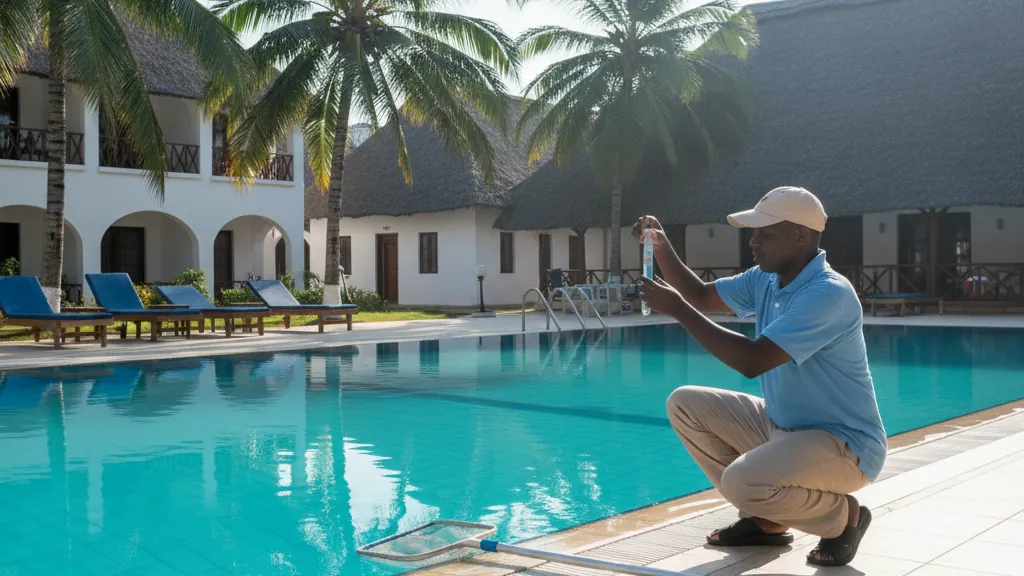
- test free chlorine and pH several times a day for busy public and hotel pools, and regularly for home pools;
- check total alkalinity, calcium hardness and cyanuric acid (stabiliser) periodically;
- keep a written log of test results, chemical additions and backwashes;
- store and handle chemicals safely: separately, dry, ventilated, locked and away from children. Never mix chlorine products with acids.
Unbalanced water is expensive. Low pH corrodes metal fittings and heat exchangers and etches plaster. High pH and hardness cause scale, cloudy water and poor chlorine performance.
Pump efficiency
The circulation pump may run for many hours a day, so its efficiency matters:
- Variable-speed pumps can run at lower speeds for routine filtration. Under the pump affinity laws, power use falls roughly with the cube of the speed, so running at half speed needs only a fraction of the power, though for longer periods.
- Right-sizing: oversized pumps waste energy and can push water through the filter too fast for good filtration.
- Clean strainers, filters and pipework reduce resistance, so the pump works less.
- Scheduling: run filtration to suit bather load. Where there is solar power on site, daytime operation can use it.
- Pool covers reduce evaporation, heat loss and debris, which saves water, energy and chemicals.
Leak detection
Unexplained water loss can be a leak. A simple bucket test compares the water loss in the pool with that from a bucket of pool water placed on the step. If the pool loses noticeably more, there may be a leak. Typical leak points include:
- cracked shells and failed tile joints;
- skimmer, light and return fittings;
- underground suction and return pipes;
- backwash valves passing water to waste.
Persistent leaks waste water and money, and they can wash out soil beneath the pool deck or the structure. Have them investigated promptly by a professional.
Preventive maintenance
Most expensive pool repairs start as small, neglected problems. A preventive programme includes:
- skimming, brushing and vacuuming to keep debris and algae down;
- checking and cleaning skimmer baskets and pump strainers;
- monitoring filter pressure, and replacing filter media when it is exhausted;
- inspecting pumps for noise, leaks and overheating, and motors and electrics for damage;
- checking dosing equipment, valves, lights and safety fittings;
- inspecting tiles, coping and grout, and repairing them early.
Safety considerations
- Supervision: children must always be supervised, and public pools need trained lifeguards or attendants as required.
- Barriers: fencing and self-closing gates prevent unsupervised access, especially at homes and apartment blocks with young children.
- Suction safety: outlet covers must be secure and undamaged to prevent entrapment.
- Depth markings, non-slip surfaces, rescue equipment and clear rules.
- Electrical safety: pool lighting and equipment installed and earthed by qualified electricians, with appropriate protection.
- Water quality: close the pool if the water is cloudy enough that the bottom cannot be seen clearly, or if disinfection has failed.
Hotels and other public pools may also be subject to inspection by county public health officers. Check the requirements that apply in your county.
Water conservation
- Use a cover to reduce evaporation, which is significant in Kenya’s warm, sunny and windy conditions.
- Backwash only when filter pressure shows it is necessary.
- Find and repair leaks promptly.
- Keep water balanced, so the pool does not need to be drained and refilled.
- Top up from a reliable, good-quality source, such as treated borehole water or stored water. See our guides on water storage and borehole water quality.
A sample maintenance schedule
| Frequency | Tasks |
|---|---|
| Daily (busy pools: several times a day) | Test free chlorine and pH; skim the surface; empty skimmer baskets; check water clarity and equipment operation; record the results |
| Weekly | Brush and vacuum; check filter pressure and backwash if needed; clean pump strainer; check alkalinity |
| Monthly | Check calcium hardness and stabiliser; inspect dosing equipment, valves and fittings; review water and energy use |
| Annually | Professional service of pumps, filters, electrics and lighting; inspect tiles and structure; review safety equipment |
Adjust the schedule to your bather load, climate and equipment. A coastal hotel pool in high season needs far more attention than a lightly used home pool.
Professional servicing
Day-to-day care can be done by trained staff, but periodic professional servicing finds problems early: worn pump seals, failing motors, exhausted filter media, small leaks and electrical faults. For hotels and apartment complexes, a written maintenance contract with clear testing records also supports health and safety compliance.
How Weber Works can help
Weber Works Ltd provides swimming pool construction, renovation and maintenance services, including pump and filtration upgrades. We can assess your pool’s equipment, water use and energy use, and recommend practical savings.
This article is general guidance as at the review date shown. Chemical dosing and safety arrangements should be set by trained operators for your specific pool.